Category Archives: Digital Nomads

Budgeting for Your Breakaway: How to Determine the Costs of Moving Abroad

The big cull: if it didn't fit into the back of the bike...it was sold!

The big cull: if it didn’t fit into the back of the bike…it was sold!

Budgeting for a big move is a prospect often fraught with angst. Whilst I agree it may well be the hardest thing you’ve ever done up until now…it need not be all that difficult. I’ll start by admitting that helping digital nomads determine the actual cost of their move is a futile exercise, considering the endless contributing factors: where do you live now? Where do you want to move to? Are you single or with kids in tow? Are you planning to ship your car and a container full of belongings? Etc etc. You get the gist.

Instead, I think the best option is to share some tried-and-tested tips on the best way you can determine the cost for yourself and (perhaps more importantly) include some insider tips on how to reduce these costs.

After all…I’m going to go out on a limb and assume this may be everyone’s priority 😉

Separate the must-costs from the maybe-costs

Your first priority should be to make a list of all the costs you envisage for your move. Things like flights, above-mentioned container shipping; apartment and/or car rental and so on. Then, think long and hard about which costs are avoidable and which are not. Yes you will have to get yourself there somehow, so flights are (for the majority) unavoidable. Tick.

Apartment rental? Nope, don’t need that yet (more on this later.) Car? Definitely not at first. Double tick.

Now your turn.

Get at least three quotes on all the must-costs

Once you have determined what you must absolutely pay for (if you’re still undecided keep on reading) then best to get quotes as soon as possible. Making the move during low-tourist season in your target country can keep flight, shipping and accommodation costs down for example, so always keep this in mind when doing your research and you could save a small bundle right off the bat.

Sell more…take less

You know how I mentioned getting a quote for shipping all of your personal belongings? Yeah…not. Stop right there.

I know how enticing it is to want to duplicate your life at home once abroad but this does contrast with most of the reasons you decided to make the BIG move in the first place. This isn’t about duplicating, this is about reshaping. If you do want to take ALL of your material possessions and envisage placing them in your new home overseas, you may want to rethink your reasons for moving. It’s a hell of a lot of hassle just to get away from the mother-in-law! Just kidding…

Placing everything in storage and leaving with the bare necessities is a great option, although if you can stomach the idea, I suggest you actually sell off as much as possible before you leave. Not only will this generate more cash (there’s your flights!) but the psychological impact it will have on you may allow you for greater flexibility in your new home-country.

I did in fact leave all my belongings in storage before going travelling. The next time I saw them was three years later when I dashed home to sell it all off: I had spent $2000 a year on storing things I never thought about, nor needed, ever again.

Food for thought? Goodie.

The dreaded housekeeping

One of the hardest decisions you’ll make will be whether or not to keep your house, if you happen not to be renting at home. This is definitely a tough choice to make. Due to my fatalist philosophies I will come right out and advice you to get rid of it; the only thing it will gift you is hours and hours of worry and work; both things you can do without. However, I also understand and accept that this may be easier said than done. Well, I did do it and it was rather easy, but you get my point.

Factoring in the costs of keeping your home at home can be hard-going. Will you rent it out? What about unexpected repairs? Will you leave someone else in charge of managing it? What about the extra expenses: can you factor them into your digital nomad income?

It will soon will become painfully obvious that keeping your home is a huge commitment, one which is hard to maintain if you happen to be on the other side of the planet; and this is just taking practical matters into consideration. I can only imagine how many digital nomads have lost countless nights’ sleep over a major issue with their homes. I don’t envy them one bit.

You’ll need less than you think

This particular credo works for just about everything you can think of. Please excuse the hanging preposition.

First of all, let’s talk high tech gizmos. By and large, I would suggest that whatever you need for one full day of working remotely from Starbucks is all you’ll ever need. I’ve seen digital nomads look like walking computer stores, whilst all I own is a small netbook, an external hard-drive and a couple of memory sticks. All three, by the way, can be purchased in almost every corner of the globe. I keep things stored on Dropbox and continually email my work to myself. Should the inevitable happen (things also go walkabouts in every corner of the globe) I won’t be jumping out of a 4-story window in despair.

Here’s something else to think about. Just because you can’t go down the road to buy milk without hopping in your car, it does not mean you ought to export this habit to your new home-country. Living without a car is not only possible and incredibly refreshing; it is also much easier to do it from the moment you arrive, when you have not yet become accustomed to the luxury of depending on one. Shipping your car overseas can be an awful waste of your heard-earned cash so I suggest you don;t even contemplate it. Likewise, leave the car rental/purchase expense in your new home country for a few months down the track. Unsurprisingly, most digital nomads who live abroad never even make this step, even after many years.

Homes are highly overrated and I do mean this in the nicest possible way. Yes it would be nice to land in Calcutta and head straight for your rental apartment, but the problem with this is that you’ll never really know how good a choice you’ve made until  you’ve seen it, smelt it and lived in it. Food and accommodation are life’s basics costs, yet holding off just a wee while on the latter can see your initial costs reduced drastically. First of all, you may want to spend a few weeks scouring suburbs of your intended abode and decide which one suits you best. Secondly, I don’t care what expat blogs/guide-books say, you are the only one who can determine what is good/bad for YOU so you do need to see it all for yourself.

Spending a few weeks in a cheap hostel will not only reduce your initial moving costs but it can prove to be highly beneficial in lots of other ways. I love hostels because they give me the convenience to stay in the heart of a city or town whilst giving me the freedom to suss it all out. You can get a private dorm to yourself/ves and enjoy the convenience of cooking your own meals, thus saving you money on food consumption as well. Most hostels will discount for long-term stays so consider it a bona fide genial option. The great thing about doing this is that you don’t need to yet budget for a rental-apartment deposit within the first few weeks. Give yourself some time to recover financially from the move before forking out even more cash and you’ll be a much happier digital nomad.

Budgeting for your move abroad is a task best tackled with nerves of steel and a sunny disposition; although most seasoned digital nomads will tell you to just chill right out. The whole point of this life-changing decision is to simplify your life and get back to the basics.

May as well start your spring-clean today.

Written by Laura Pattara

Leave a comment

Filed under Digital Nomads, Finances and Budgeting, Location Independence, Preparing to Breakaway

The wandering digital nomad challenge: how to achieve a work-travel balance

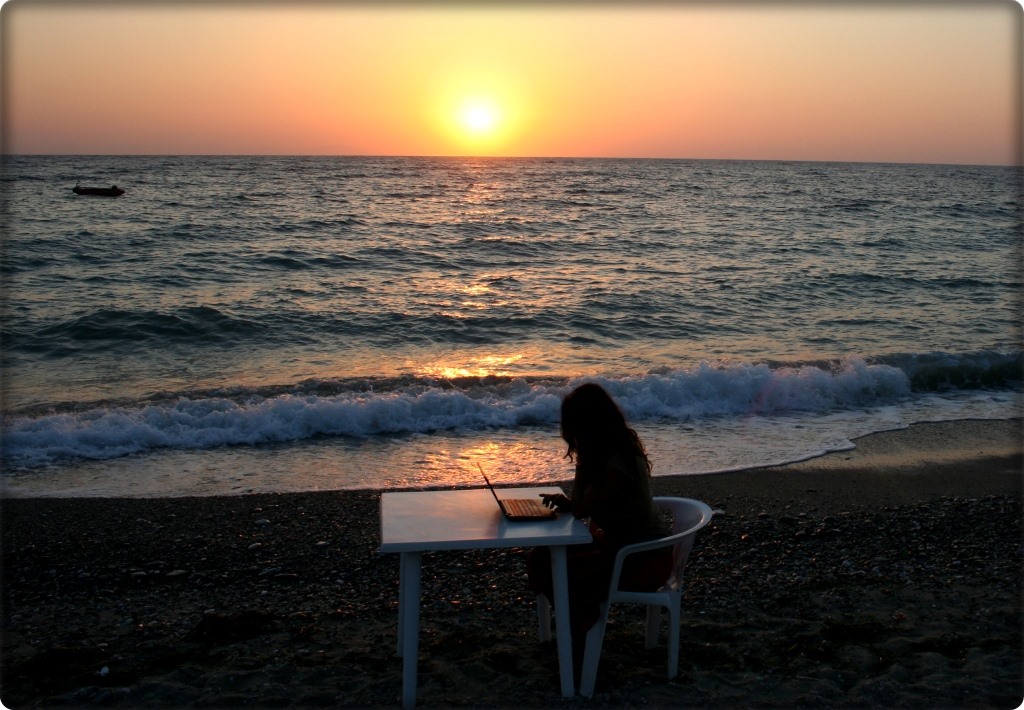
View from my desk in a campsite on the Albanian Coast. It's a hard life, I know...

View from my desk in a campsite on the Albanian Coast. It’s a hard life, I know…

‘How do you manage to work and travel simultaneously?’ is possibly my most oft-asked question. Whilst some digital nomads are indeed blissfully located somewhere, usually for an extended period of time, I am a member of a small group of challenged individuals who are actually located everywhere, all the time. My partner and I are currently riding our motorbikes from Germany to Australia; we’ve travelled through 15 countries in the last 15 months, lived in a tent most of the time and I’ve managed to write almost 500 travel-related articles along the way.

Challenging enough? You could say that…

Yes it is true that wandering digital nomads face a few more challenges than their more settled (and some would say sane) counterparts, yet finding a way to earn money whilst travelling is by no means an impossible task to accomplish.

If you’d like to know how I manage my own work-travel balance, and get a few ideas on how to tackle this challenge yourself, now would be the time to continue reading.

1)      Establish good working relationships

If you’re planning to become a self-employed digital-nomad, feel free to skip this point altogether. If your income will depend on others however, do take special note.

All digital nomads will spend a serious amount of time setting up a good virtual job before they start packing their bags. Most of the time, they won’t consider making the big move until they’ve secured their needed income. This is, suffice to say, an excellent choice.

Vagabonding digital nomads however, must also establish work contracts with people who understand that they are going to be constantly moving around. This turned out to be easier than I had anticipated, although I admit that the fact I only work within the travel niche may have something to do with it. Travellers dig travellers!

You can start off every month with the best intentions in the world, but let it be known that the life of a long-term traveller is one of complete and utter chaos. Most of the time. Finding a sympathetic ‘boss’ (or three) was my top priority before leaving, and something which I recommend you do as well. No matter who it is you work for, they must realize that whilst you’ll endeavour to deliver/contact/skype/email, sometimes you just won’t be able to, end of story. The internet will be down; you’ll be stuck in the middle of nowhere with a broken bike-part, you’ll be sick etc. This is why it is just so imperative that you build up a good reputation as a professional and conscientious worker and establishing a trusting relationship with your work provider. Should the inevitable happen, this will ensure the boss is not left disappointed and you are not left unemployed.

The fact that I also held a daytime job and learnt a new language during my pre-departure period is testament to the fact that…

2)     You should learn to be a multi-tasking-master

Juggling several balls simultaneously is what I do best and something with which I have the most experience. Before meeting Chris I’d worked as an overland tour guide for five years and mastered the skills of multi-tasking. After spending years answering 24,000 questions a day whilst making a mental food-shopping list and finding time for email answering, account keeping, problem solving, activities booking, mental-breakdown-preventing, leg shaving and travel itinerary researching… I knew I could do anything simultaneously 😀

Squeezing 27 hours out a 24 hour day is child’s play (once you get the hang of it) and a perfect skill to have when desiring to work and travel concurrently. The most important part of this talent is that teaches you what I call ‘mental multi-tasking’: the ability to switch your working and travelling brain on and off at will. This was by far my most challenging hurdle in the first few months; I needed at least two days to go from sightseeing and bush camping to writing a coherent enough travel article my boss would be willing to pay for! The process is getting easier and easier as the time passes and I have gotten to the point where I can go from spending five days crossing the Caucasus Mountain Range to churning out a decent amount of work, with just a good night’s sleep, a decent shower and a strong cup of coffee.

The good news here is that this is indeed a learned talent and something anyone can actively practice. Manage your work time efficiently and you won’t ‘waste’ a minute of your day.

3)     Find your groove & perfect your work routine

Whilst I may be a mental-ninja, I’m not superhuman, which means I can’t actually visit a historical site and write a travel article at the same time.

The options of work routine are various, so you may have to try out a few scenarios before you know what works best for you.

What I have managed to do is set up a completely imbalanced life balance which seems to work a treat for me: I travel most of the time and only work some of the time. I’ll stay put for a week in one spot with good internet and comfortable living quarters and work (at a campsite with a cosy cafe’, hostel or rental apartment), then travel for 3-4 weeks after that. Sometimes I also play it by ear and fit in a couple of working days when the weather sucks or if I happen to be in a particularly productive mood. This is also the reason I only accept monthly travel article requests; knowing ahead of time what I need to deliver in a month gives me the freedom to rearrange my days as I see fit.

I’ve known of digital nomads who travel and work on a 3 or 6-month-rotation basis and this may well turn out to be your preferred method. In the digital-nomad world, this is called ‘cycling’. It actually sounds perfect to me personally, yet my particular trip is so physically demanding (I’d never even ridden a motorbike before) that I really couldn’t travel non-stop for three months straight without a week-long break somewhere along the way. My work week has also become my rest & recuperation week. See? There’s that multi-tasking thingy again 😉

I plan my work-week about two months in advance and research what seems to be the ideal place to stop. A capital city, for example, will always be a good bet even in the most undeveloped countries; chances that you’ll find a decent place to stay with good Wi-Fi are surprisingly high the world over. This little plan has turned out to be ideal for me, because I don’t particularly like cities. Having to bunker down and work for a week straight in the big smoke is infinitely less painful than trying to do the same in a gloriously small beachside campsite on the southern Mediterranean coast in Greece in July. Now THAT was painful.

4)     Slow is key

When all is said and done, the only thing which will ensure your success as a wandering digital nomad is time. Give yourself lots of it; you’ll need it.

The only way Chris and I can manage to live as we do is because we travel so incredibly slowly. We cover only about 1,000kms a month and usually only visit a few places in each country. We’ll ride just a couple of hours each day and usually camp for a few nights in each spot. We tend to move faster during summer and spring and a little slower during the colder months, when bad weather can see us ‘stuck’ in one place for two weeks at a time, or more. When you’re a digital nomad you’ll never resent a rainy day on the road!

We are actually, for the first time in years, about to settle down for the winter in one single spot. I’ve recently been offered the amazing opportunity to write a long-term traveller’s guide book for a European publishing company and wish to do so from the comfort of a rental apartment in Tbilisi, Georgia. This will not only give me the chance to try ‘cycling’ for the first time ever, but it will also provide me with enough income should our intended crossing of Central Asia next year prove to be a tad work-challenging. I guess I’ll just have to wait and see how that pans out. Keep you posted!

You should realize by now that there is no such thing as an ‘ideal work-travel balance’ for nomadic digitalists…different strokes for different folks really is quite the apt adage in this case. Find your own grove, routine and balance and, most importantly, remember to love what you do.

Manage this…and you’ll always find a way to make it work.

Written by Laura Pattara 

1 Comment

Filed under Digital Nomads, Travel Tips, Working Remotely

Arthur C. Clarke Predicting Digital Nomads in 1974

A great quote by Arthur C. Clarke in 1974 talking about computers and basically predicting the internet and location independence.

“They will make it possible to live really anywhere we like. Any businessman, any executive, could live almost anywhere on Earth and still do his business through a device like this,” he says. “It means we won’t be stuck in cities. We’ll live out in the country or wherever we please and still carry on complete interactions with other human beings as well as computers.”
– Arthur C. Clarke, 1974

Leave a comment

Filed under Digital Nomads, Location Independence, Technology, Working Remotely

Listen to this: Don’t Quit Your Day Job (Digital Nomad Podcast)

digital-nomad-podcast-splash

The Digital Nomad Podcast is a great series of shows by Alondo Brewington and Warren Moore, two super smart entrepreneurs who have had some success in breaking free. One in particular that grabbed my attention is Episode #11: Don’t Quit Your Day Job in which they address the realities of launching a business. They don’t get too far into the specifics of trying to launch a business while you’re remote, but it seems the remote part is somewhat implied, which the focus being on the business part. Some great takeaways are that you should give yourself at least a year (12-18 months worth of cash to support yourself) at launching something and highly consider having something steady on the side while you get your business going. They also make mention of a post by Jacques Mattheij’s called “It Takes Three Years to Build a Business“, which is a great read.

I commend them on bringing this topic up because it seems there is a lot of misinformation as to what people should do and how they should go about it. As a general rule I feel trying to do both things at once, launching a business and beginning a move or travel adventure are not a wise decision. As always, I will cheer on those who flat out go for it and make it work, plenty of us wouldn’t have gotten where we are by heeding the warnings of others, but when there are a series of steps you can take to have more success, it is worth your time to consider them. We’ll always do our best to have stories of various types, from those who were more careful and calculated about how they went remote to those who quit their jobs, sold everything and went for it, but personally I will always lean towards keeping your income scenario steady and stable. Keep your job or continue running your business and changing your location. Visit the Digital Nomad Podcast website and listen to episode 11 and all the others, you’ll be glad you did!

Leave a comment

Filed under Digital Nomads, Motivation, Work and Business

Breakaway…how to free yourself from those invisible shackles

Breaking free from my previous life was not easy...but boy was it worth it :)

Breaking free from my previous life was not easy…but boy was it worth it 🙂

The decision has been made. You’ve spent months (sometimes years) debating with your soul about what it is, exactly, that you want from life. Once you’ve finally realized that breaking free is your ultimate goal, you think all your problems are over. That’s it! The hard part is over! You’ve made the decision to cut the shackles which are holding you back and to set off into the sunset; oh how wonderful do you feel right now?!?

Forgetting something? Not so fast there cowgirl…

Yes it is true that the hardest part, for me personally, was coming to the realization and making the final decision, that long-term travel was what I craved most. Yet this does not mean by any stretch of the imagination, that what came next was pure bliss. It wasn’t. It was a bit hellish actually. I had an apartment to sell and the contents to store, I had to disconnect from everything in my life, hand in my resignation, pay off my credit card, close all my accounts and, if all that wasn’t enough, I had to break the news to my mum. Once you learn my mum is Italian, then you’ll understand my angst ^_^

Handing over the keys of my former abode to the real estate agent felt like a huge relief. Sort of. You see, everything about the ‘breakaway’ was immensely contrasting for me: I was elated yet hesitant, adventurous yet cautious. Nothing about it was black and white and, to tell the honest truth, nothing has been ever since. I love travelling with every inch of my soul but at times I get homesick, friend-sick and mamma-food-sick. Whilst I cherish making new friends every day I miss having D&Ms with my life-long friends. I dare say that life for most long-term nomads is one of contrasts and contradictions, so I suppose the internal turmoil I felt when I was in the midst of reorganizing my life  was Mother Nature’s way of telling me ‘well you better get used to that kid…there’s a lot more where that came from!’

Being virtually homeless at the age of 31 felt a little scary although having a 3m³ storage space full of my ‘stuff’ helped alleviate my fears. This was my back up plan, my fall-guy, this was my way of saying that while I very much wanted ‘out’, I did also want to leave the door ajar. Just in case.

Considering that the next time I saw my stuff was when I flew home three years later to sell it all off, one would think that I’d be an ardent advocate for complete and total initial sell-off. But I’m not. Sure, sometimes I kick myself at having spent $6,000 over three years to store things I never needed nor wanted again, but I do think my gradual detachment from what I sometimes call my ‘previous life’ was exactly the right recipe for me. I’ve had people ask me how one just breaks away completely and sets off, but fact is I have no idea how anyone could do that either! I did it in steps and it worked a treat and this is something I would highly recommend to anyone who feels a little nauseous at the mere thought of ridding themselves of their life-long’s possessions. I can plead and beg and swear to you that you won’t give two hoots about them in two years time, but fact is everyone needs to get there on their own.

I left my car with a friend who paid and maintained it whilst she used it (sold that two years later), consolidated all my accounts into one and took a debit VISA card with me (incidentally this is still the only bank account I have) and I did take out an emergency MasterCard for the unthinkable. Knowing that I could buy a flight home at ANYtime helped put my mind at ease.

Those who are intending to live an expat existence in another country will probably have an easier time I dare say, but of course cutting off from the emotional attachments in our lives will always be the biggest challenge. It really does help to keep in mind that, this being the 21st century and all, one can get back ‘home’ in two days from just about every corner of the globe. Your chosen financial step of choice (do you live off your savings a while, make virtual connection before you leave etc?) will also determine just how nervous you’ll be at the airport, yet I imagine that even the most organized wannabe-nomad will suffer many sleepless nights.

Taking all the necessary steps you need to free yourself from your restrictions is never going to be the easy part. Emerging from the other side unscathed however, will definitely be the most rewarding.

Welcome to your new life.

Written by Laura Pattara

2 Comments

Filed under Digital Nomads, Location Independence, Motivation, The Breakaway, Working Remotely